
Honestly? It doesn’t need to.
“My phone is listening to me” is practically a meme at this point. But the boring truth is scarier. You’ve already handed over enough data to predict what you’ll say, through privacy policies you agreed to without reading.
And I finally have the perfect example.
My wife and I have been trying to start a family for a while now.
A few months ago she noticed her Instagram feed shifting. That part wasn’t surprising: she uses the apps that feed on exactly that kind of signal. What kicked off the conversation at home was that mine hadn’t moved at all.
Meanwhile, I’d been talking about it for months in my privacy-first corner of the internet: Proton Mail, Brave, ad blockers. For months, no advertiser seemed to know a thing.
Then, in a LinkedIn message to a connection, I mentioned we were trying to start a family. Same day, I open Amazon and get served baby products.
Can I prove LinkedIn was the leak? No. And honestly, that’s the point. The ecosystem is so leaky that I can’t even tell which tap is dripping. But it’s the only place I think it could have come from, especially given the timing. One sentence, in one place that wasn’t private, and the profile snaps into focus.
“But LinkedIn is the professional one!”
Sure. It’s also a platform regulators have already caught profiling users for ads. In 2024, Ireland’s Data Protection Commission fined LinkedIn €310 million for breaking EU law on processing personal data for behavioural analysis and targeted advertising. The regulator found that the consent LinkedIn got from users wasn’t freely given, properly informed, specific, or unambiguous.
Read that again: the “professional” network didn’t have valid consent to profile you for ads. That isn’t a conspiracy theory. It’s a regulatory decision.
This is how they “listen”
Every “accept all cookies.” Every app installed without checking what it collects (looking at you, Meta and Google, y’all are hungry for my data and I don’t trust that vibe). All of it gets aggregated, sold, scraped, and passed around to build a profile of who you are.
Even your “public” profile is fair game for scraping (collecting publicly available data at scale). In 2021, a dataset of 700 million LinkedIn users, with names, emails, phone numbers and industry info, was put up for sale on a hacker forum. LinkedIn’s defence? It wasn’t a breach, just data scraped from LinkedIn and combined with other sources. Cool. Very reassuring.
The more they have, the better they can predict who you are and what you’re likely to buy, and the more it feels like someone’s listening.
The golden rule: your smart TV should never touch the internet
Your phone might not need to listen. Your TV, though? That one has a track record.
- 2015, Samsung: Samsung’s smart TV privacy policy literally warned owners that anything personal they said around the voice recognition feature could be captured and sent to a third party. People compared it to 1984. They weren’t wrong.
- 2017, Vizio: Vizio paid $2.2 million to settle charges from the US Federal Trade Commission (FTC) and New Jersey that it tracked what 11 million TVs were watching, second by second, without consent. It then shared that data with third parties for ad targeting. It even pushed the tracking software onto TVs people had already bought.
- 2025, basically everyone: Texas sued Sony, Samsung, LG, Hisense and TCL over Automatic Content Recognition (ACR), tech that can screenshot whatever is on your screen every half second and report it back. Samsung and LG have since settled and agreed to ask for consent first (wow). Notice they had to be sued into asking.
- 2026, LG (again): Researchers found LG smart TVs converting voice commands into text and storing them in logs, capturing microphone audio while the TV appeared to be off in standby, and scanning your home network for every other device on it. (LG says that’s not true.)
LG is just the latest. The pattern is the business model: the TV is cheap because you’re the product. So treat it like a very nice monitor. Never give it your Wi-Fi password, and never plug it into your router. If it’s already connected, disconnect it and factory reset it.
What you can actually do
-
Switch your browser. Firefox, LibreWolf, or Brave all block a lot of tracking by default. Chrome is made by an ad company. Act accordingly.
-
Install an ad blocker. uBlock Origin is the gold standard: install it and forget it, and it works best on Firefox and Brave. Want to level up? Run a network-wide blocker like Pi-hole or AdGuard Home, and protect every device in your house at once.
-
Move away from Big Tech wherever you can. Every service you replace is one less profile feeding the machine:
- Proton Mail or Tuta instead of Gmail
- Signal instead of WhatsApp or Messenger
- Proton Drive or a self-hosted Nextcloud instead of Google Drive
- DuckDuckGo, Startpage, or Qwant instead of Google Search
-
Reject non-essential cookies. It’s usually one extra click, and some browsers and blocker extensions do it for you (Brave does it automatically for me).
-
Audit app permissions. Check mic, location, and contacts on your phone. If a flashlight app wants your contacts, it’s not a flashlight app.
-
Opt out of ad personalisation on the accounts you can’t quit yet: Google, Meta, Amazon, LinkedIn.
-
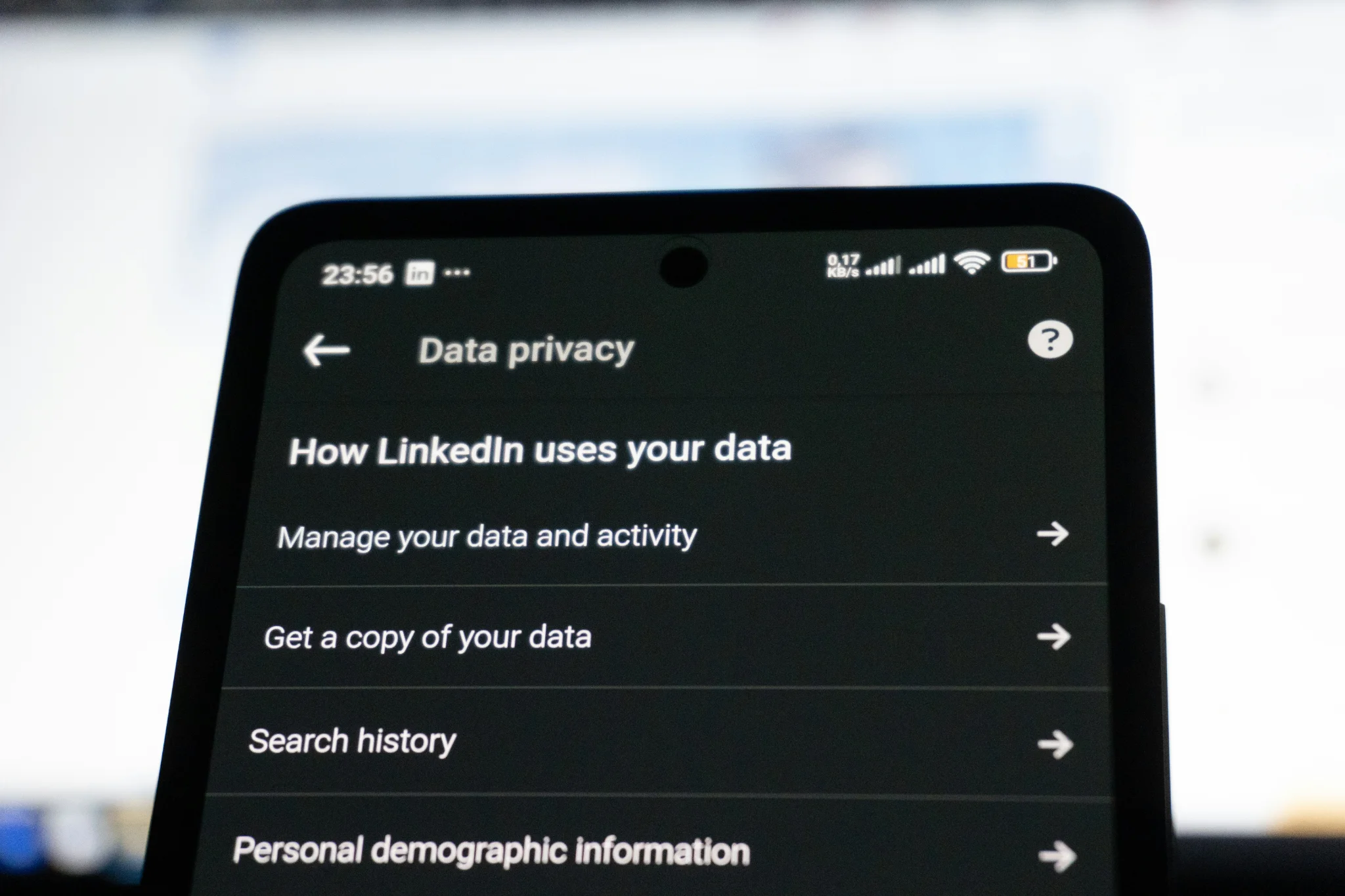
Turn off AI training wherever you can. On LinkedIn, for example, go to Settings & Privacy → Data Privacy → How LinkedIn Uses Your Data, and switch off “Data for Generative AI Improvement”.
-
Keep sensitive topics on private tools. A “private message” on a social platform isn’t the same as a private conversation.
-
Keep your smart TV offline. Use an external streaming device like an Apple TV, or a small computer running something like Kodi or Jellyfin if you want full control.
None of this is new
Back in 2012, Target figured out a teenager was pregnant before her family did, just from her shopping habits. The article is paywalled, so here’s a video that walks through it. Over a decade later, the tools are sharper and the data is richer.
My hope is that this gets you asking where your data is leaking, so you can make informed choices about it.
With care,
Your cybersecurity girly
Photo by Zulfugar Karimov on Unsplash