

Somewhere around year ten of a tech career, something quietly breaks. You’re asked to update your CV, or a recruiter calls, or you sit down to build a portfolio — and you realise you can’t actually remember half of what you’ve done. The companies you built things for kept those things. The repos stayed behind. The Confluence pages are behind a login you no longer have. The Jira board got archived. And you’re left trying to reconstruct a decade of professional identity from memory, a handful of LinkedIn bullets, and a CV template designed by and for someone who is not you.
That was me earlier this year. Thirteen years into a career spread across four countries, with somewhere north of 170 professional tools touched along the way. I was building my portfolio site and I had a data problem: I couldn’t tell you, from memory, which of those tools I use daily, which I could pick back up in a week, and which I should quietly stop listing. I had the headlines. I’d lost the substance.
So I built a tool to fix it, and I’m sharing it today. But first — try this.
Try this before you keep reading
No Googling, no peeking at LinkedIn. Just answer:
- How many tools have you used professionally in the last five years?
- What’s the most important thing you did at your last company that isn’t on your CV?
- What’s a skill you have right now that shows up nowhere in your professional profile?
If any of those took longer than five seconds — hi, welcome, this one’s for you.
The CV was designed for someone else
The standard CV makes assumptions about the person filling it in. That you have a relevant degree. That your experience is deep and narrow — a decade spent becoming a specialist. That your story is a straight line.
None of that is true for me, and I’d bet it’s not true for a lot of you.
I’m self-taught. The education section of any CV I produce is either thin or misleading — I enrolled in medicine, left after a year, and found my way into tech through curiosity and a thirst to learn, not curriculum. I learn fast and pivot fast, and I did a lot of both early on; experimenting with different roles was how I figured out what I’m good at and what I love. I’m a generalist: QA engineer, automation lead, release manager, head of quality, QEE & platform engineering manager. First QA hire at four different companies. I’ve worn enough hats that “technical background” barely covers it.
And — here comes the fun bit — I have ADHD. Which means I get bored quickly, learn constantly, and accumulate a very broad, sometimes patchy technical picture. The breadth is a genuine advantage: I can hold a conversation with an SRE, a PM, a mobile dev, and a data scientist and be useful in all four. Brilliant for leadership. But the flip side is that reconstruction is hard. When I haven’t touched a tool in three years it’s not just dusty — it’s genuinely hard to find in my own mental index, and digging for it costs energy my tired brain would rather not spend. It feels like something I already have… somewhere. Scattered across a dozen places.
And don’t get me started on my stack. Now that I’m a manager it’s like maintaining several versions of myself at once — the stack I can build on, the one I can test on, the one I can lead on. The CV has no row for “I know this well enough to debug it, lead a team using it, and evaluate it in an architecture review, but I haven’t written a line of it in two years.”
For people like me, the result is a document that quietly undersells everything we bring.
A CV is a story — and engineers are terrible at writing docs
A year or two ago I worked with Emily Pearlman on the latest version of my CV, and it changed how I think about all of this. Emily’s whole approach is that a CV, an interview, a career — none of it is a list of facts. It’s a story. Who you are, what you care about, and the through-line connecting roles that might otherwise look scattered. For a generalist, that reframe is everything — it became the basis not just for this tool and this site, but for how I see my whole career now. (Highly recommend Emily, if you were wondering.)
But here’s the catch nobody warns you about: telling your story well needs raw material, and most of us — engineers especially — don’t keep any.
Think about what a good story actually needs. The specifics. The number. “I reduced onboarding friction” is nothing; “I cut new-engineer time-to-first-commit from two weeks to three days” is a story. But who, in the moment, stops to calculate that? Who writes it down somewhere they’ll still find it two years and one job later?
I don’t naturally think in percentages. I couldn’t tell you off the top of my head how much I reduced anything by — not because it didn’t happen, but because measuring it and keeping the measurement is a separate discipline from doing the work. And it gets so much harder the moment you move from IC to management. As an engineer, your output is tangible — there’s code at the end of the day. As a manager, your impact is diffuse: it lives in other people’s growth, in incidents that didn’t happen, in teams that kept running while you were on leave. If you don’t capture it as it happens, it evaporates. And nobody teaches you to, because the people who’d teach you are also engineers who never learned to either.
What big companies do to your professional memory
There’s a specific trap in joining a large organisation: they’re very good at capturing your contribution inside their systems, and very bad at giving any of it back when you leave.
What stays behind:
- Your commit history (their repo)
- Your documentation (their Confluence)
- Your runbooks (their wiki)
- Your onboarding guides (their Drive)
- Your interview frameworks (their ATS)
- Your team’s culture and norms (in the heads of people who’ll carry on without you)
What you walk away with:
- A LinkedIn bullet point
- A PDF nobody will read
This isn’t malicious — it’s just the physics of institutional infrastructure, plus access control when you get down to it. But for anyone who’s worked across several companies, especially ones that got acquired, folded, or simply revoked your access the day you left, the gap between what you contributed and what you can prove you contributed grows uncomfortably wide.
Thirteen years in, I was forgetting roles. Not the headlines — the details. The specific stack at one company in 2020. The automation framework I built from scratch at another. The DEI hiring pipeline that’s probably still in use. The metric I introduced that someone’s still watching on a dashboard somewhere.
I tried not to build this
Before writing a single line of code, I went looking for something that already existed. Surely, I thought, someone has needed this before. Surely there’s a tool for collecting your professional stack and experience in a structured way.
Turns out I’m either unusually weird or I stumbled onto a real niche, because there was very little. I made a StackShare account — promising, a place to catalogue your tools — and promptly watched my freshly created personal stack mysteriously vanish, leaving me to start over and hope it stuck the second time. Not a confidence-builder for a tool whose entire job is remembering things for you.
Then, by complete coincidence, roadmap.sh came up at work. It’s genuinely lovely for mapping out knowledge and learning paths — but it’s built for “what should I learn next,” not “what have I already done and how well do I know it.” Close, aimed elsewhere.
And yes, I could’ve just opened a note and typed it all in. But come on. Excavating thirteen years of your own career is already tedious and faintly demoralising — why not at least make it nice? Multiple choice where possible, a star rating you click instead of a sentence you have to compose, something closer to a quiz about yourself than to filing taxes. If the task is boring, design your way out of the boredom. We work with the ADHD brain, not against it, in this household.
So, I built a thing
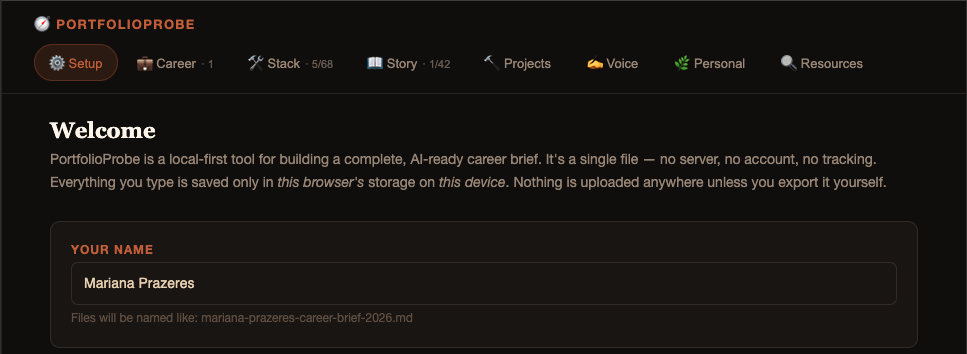
The result is a single HTML file that runs entirely in your browser. No backend, no login, no subscription, nothing sent anywhere. Your progress saves automatically as you go — it lives in your browser’s local storage, so you can close the tab, come back next week, and pick up where you left off. That matters, because this is not a one-sitting task. (It is vibe-coded, though, so follow my lead and don’t trust it too much — it’s just nice not to lose everything when your tablet locks mid-thought about what you did seven years ago.) When you’re done, you export, and keep it wherever you track things.
The sections:
Career — role by role, with fields for the things CVs don’t ask. The specific achievement with a number. The war story. The thing that should’ve made the profile but didn’t.
Stack — every tool you’ve touched, with a 1–5 rating and a category: currently active, I develop with this, QA / testing experience, can pick back up, hobby or exploratory. These are tailored to me right now — but hey, I’m kind of hoping to start a community thing here.
Story — the questions nobody asks in interviews but that actually explain who you are. The pivot. The geographic choices. The move into management. The context that makes the decisions make sense.
Voice — your actual opinions. The hot takes. The things you’d do differently. The talk you’ve always wanted to give.
The export is the useful part: a clean Markdown file you can hand to the AI of your choice to help write a bio, a cover letter, or a portfolio that actually sounds like you — instead of the generic mush you get from feeding it a stale CV. Here’s a snippet of mine:
Docker:     ★★★★★ [active]  — daily driver, comfortable leading
Python:     ★★★★☆ [develop] — strong, use for tooling and automation
Golang:     ★☆☆☆☆ [dormant] — tested Go software professionally, want to write it
Terraform:  ★★☆☆☆ [skip]    — familiar enough to read it, not claiming it
That last line — being able to write skip, I’m not claiming it — is the whole point. Honest self-assessment is something no CV format allows, and it’s far more credible than the usual wall of logos implying mastery of everything.
What it changed
The exercise turned out to be more valuable than the output.
Rating my own stack honestly made me face the gap between the skills I claim and the skills I actually have ready right now. “Have you used this?” and “could you lead a team on this on Monday?” are very different questions, and the tool makes you answer the second one. The career deep-dives surfaced things I’d compressed into single bullets that actually held three or four things worth saying out loud — and revealed a few roles I’d been quietly over-crediting in my head. The honest version of my career turned out to be more interesting than the polished one.
But the biggest change is in how I work now. Having done the painful archaeology of reconstructing thirteen years from memory, I really don’t want to do it again. So when I finish something I’m proud of — ship a thing, fix a culture problem, move a metric — I stop and capture it. The number, the context, the before-and-after. Not for a performance review. For me. Because the version you write down today is always more accurate than the one you’ll try to reconstruct in three years.
You can use it too
It’s open source and lives here: PortfolioProbe.
One HTML file. Download it, open it in your browser, work through it at your own pace. Everything stays local, the export is yours to keep. Want a head start? Download my completed profile, hand it to your AI of choice alongside your old CVs and LinkedIn export, and ask it to build yours from the same structure — answering its questions as it goes.
It was built from my career and my needs, so you’ll hit questions that don’t apply to you and probably miss angles that matter for your path. Forks and contributions are welcome — especially question sets for careers the current version doesn’t serve well yet. And if you use it, I genuinely want to hear how it went: hello@mprazeres.dev.
Your company has been tracking your contributions since day one. Time you started doing the same.